Surety Bond API Integration Turns Self-Service Into More Revenue
Key takeaways:
- A national retirement-plan platform now handles onboarding plan sponsors from start to finish, then automatically routes that information to Merchants Bonding's surety bond API to issue the required ERISA fidelity bond.
- The agency of record keeps the commission and the relationship, without any duplicated data entry.
- Any online software platform with a statutory bond requirement, not only ERISA plans, can use the same integration model.
- Since going live, the integration has saved platform an estimated $4 million in bond premium.
An online platform could move through design, record keeping, and enrollment, then get stuck on the bond step. The platform can't complete the onboarding process until their client obtains a surety bond.
"Without the API, the client was ready to go but could be delayed up to one week waiting for a bond," says Eli Krambeer, AVP of Commercial Underwriting. "Now the bond is part of signing up. It's one less place things can stall."
Anywhere an online platform onboards a business that has a legal bond requirement, the same stall shows up. Each manual handoff is a chance for the client to abandon the application and for the platform, that's revenue left on the table.
Merchants Bonding's API integration provides a faster path for the platform and plan sponsor, as well as continuity for the agency of record.
Why every new 401(k) hits a bond requirement
The stall traces back to ERISA §412, the section of the Employee Retirement Income Security Act (ERISA) that requires plan officials who handle plan funds to obtain a fidelity bond. The bond protects participants from loss due to fraud or dishonesty, not investment losses, and the Department of Labor's ERISA fidelity bond guide requires it before a plan can operate.
Coverage must equal at least 10% of the funds handled, with a $1,000 minimum. Bond amounts top out at $500,000 per plan in most cases, or $1 million for plans holding employer securities.
The rule doesn't change for smaller or newer plans.
Meeting that requirement used to mean leaving the platform, applying separately, and waiting.
How does the surety bond API integration work?
The surety bond API integration lets a software platform request, underwrite, and issue a surety bond directly through an API. An API is like a handshake between systems, making it possible for the one software to communicate and share data directly with another system.
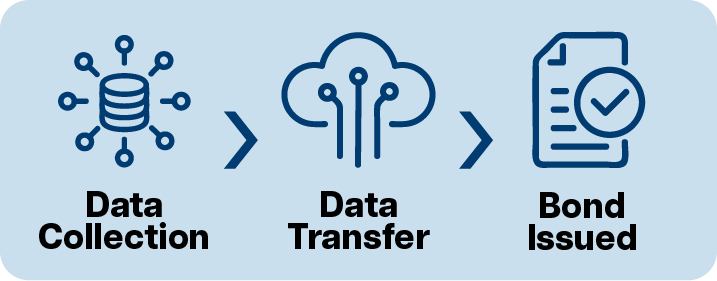
In this case, the retirement platform gathers the plan sponsor's information and completes onboarding, then sends that data to Merchants Bonding through the API to issue the required bond. This means requestors can skip the traditional process where manual steps and extra paperwork can slow things down. The setup still involves three parties (including the agency), and all three stay visible in every transaction.
Bonding made better: the API integration payoff
In the case of the ERISA platform, their bond premium was much higher with its previous carrier before switching to Merchants Bonding. Since making the switch, the Merchants Bonding's API integration has saved the retirement platform an estimated $2.5 million in annual bond premium.
"The platform already had the plan and principal information from onboarding, so we just needed a way to get the bond process started," Krambeer says. For this ERISA integration specifically, that means the bond issues automatically, with no manual underwriting required. More broadly, Krambeer explains that the amount of time it takes to move from "requested" to "issued" on any bond depends on that bond's requirements: "If the bond doesn't require underwriting documentation, or it's only a simple credit check of the owner, the bond can be issued instantly. If there's a more complex bond that requires manual underwriting review, we still turn it around within 24 hours."
No party gets removed from the picture; the agency keeps the business.
Results that speak for themselves
If time is money, the API integration saves both. Because bond issuance now runs inside the platform's own onboarding process, onboarding moves faster, which expedites turnaround for the plan sponsor. A fidelity bond that used to take a manual email exchange and up to a week to process now issues in minutes.
The bigger number is the savings: since going live, the integration has saved the plan sponsor an estimated $4 million in bond premium. Real dollars back, not just faster paperwork.
"We've seen this model produce six- and seven-figure opportunities where it's been deployed, and the ERISA integration is the proof it works inside a live product, not just in a pitch deck," says Krambeer.
What made it easy to build
Online platforms considering this kind of integration usually ask the same question first: how much work does it take to set up an API?
Merchants Bonding's in-house technical implementation team, based in our West Des Moines office, leads the build.
"Once we get the green light from the online platform or agency's team, we begin implementation and testing. Within one week, the API is up and running issuing bonds," said Scott Robinson, AVP of Web Development. He added, "Every integration gets its own test environment, where a platform can validate instant issue, pending review, corrections, and error scenarios before anything goes live."
That hands-on onboarding is what lets this platform move from the first conversation to a working integration without standing up a project team of its own.
Surety bond API FAQs
| What is a surety bond API? |
| A surety bond API is a system-to-system connection that lets a software platform request, underwrite, and issue a surety bond from inside its own product, instead of sending a user to a separate agency or carrier site. Merchants Bonding's API supports quoting, ordering, issuing, and servicing bonds directly from a connected platform. |
| Does the agency still earn commission on a surety bond API? |
|
Yes. The agency of record tied to the platform relationship keeps the credit and the commission for every bond issued through the integration. The API removes manual data entry and processing, not the agency's role in the transaction.
|
| What kinds of online platforms can use this? |
|
Any software that licenses or onboards other businesses into a role with a statutory bond requirement is a fit, including retirement-plan administration, mortgage origination, freight brokerage, motor vehicle dealer licensing, notary commissioning, and licensed contractor onboarding. The common thread is a legal bond requirement that currently sends users outside the platform.
|
| Is an ERISA fidelity bond legally required for a 401(k) plan?? |
|
Yes. ERISA §412 requires most plan officials who handle plan funds or other property to be covered by a fidelity bond before a retirement plan can operate. The U.S. Department of Labor sets minimum coverage at 10% of the funds handled, with a $1,000 floor and, in most cases, a $500,000 cap per plan.
|
| How long does an integration take to set up? |
|
Timelines vary by platform. Merchants Bonding's in-house integration team works directly with a platform's developers through a dedicated test environment built to validate instant issue, pending review, and correction scenarios before launching.
|
Next steps
See it in action: watch Mike and Scott walk through onboarding and the mechanics of the integration of Merchants Bonding's API product page.
If you're an agency with a relationship like this one in your book, use it to start that conversation, then loop in Merchants Bonding's tech team to talk through what an integration would look like.